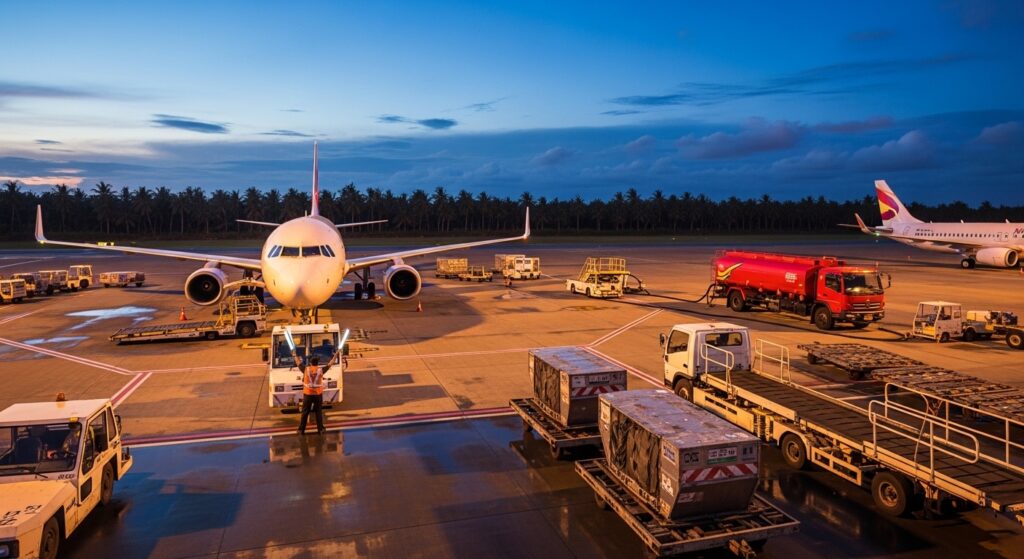
Ramp Handling Services at Bali Airport (DPS)
Professional apron operations for narrow-body and wide-body aircraft at I Gusti Ngurah Rai International Airport. Marshalling, pushback, loading, GSE operations, and turnaround management — DGCA certified since 2015.
Daily Movements
All Aircraft Types
Target Turnaround NB
Quick Answer: Ramp handling at Bali Airport (DPS) encompasses all aircraft ground operations on the airport apron — including aircraft marshalling and parking guidance, pushback and towing, baggage and cargo loading/unloading, ground support equipment (GSE) positioning, fueling coordination, water and lavatory servicing, and Foreign Object Debris (FOD) prevention. Bali Ground Handling provides ramp services for both narrow-body (A320/B737) and wide-body (A330/B777/B787) aircraft with turnaround targets of 30-45 minutes for domestic and 60-90 minutes for international operations.
What Is Ramp Handling at an Airport?
Ramp handling — also known as apron handling or below-wing services — refers to all ground operations performed on the airport ramp (apron) to service aircraft between arrival and departure. This is the physical, operational core of ground handling: the teams and equipment that physically move aircraft, load and unload baggage and cargo, provide ground power and air conditioning, service water and lavatory systems, and coordinate the complex choreography of vehicles and personnel that surround every aircraft during its ground time.
At I Gusti Ngurah Rai International Airport (DPS/WADD), ramp handling is particularly demanding due to the airport’s operational profile. With over 170 daily aircraft movements across a single runway, turnaround efficiency directly impacts slot availability for subsequent flights. The tropical environment — average temperatures of 27-33°C, humidity above 80%, and monsoon rainfall during wet season — adds environmental challenges that require experienced teams and maintained equipment. And the airport’s mix of narrow-body domestic operations (requiring rapid 30-minute turnarounds) alongside wide-body international flights (with 60-90 minute windows) demands operational versatility across aircraft types.
Bali Ground Handling has provided ramp services at DPS since our establishment in 2015 as part of the Juara Holding Group. Our ramp operations cover IATA SGHA Section 3 (Ramp Handling) in its entirety, with all personnel holding DGCA-mandated ramp safety certifications and aircraft-type-specific training.
Aircraft Marshalling & Parking
Aircraft marshalling is the visual guidance of arriving aircraft from the taxiway to its assigned parking position on the apron. Our certified marshalling teams use standard ICAO hand signals and illuminated wands (for night operations) to guide aircraft to the exact parking position, ensuring correct alignment with the jet bridge (for contact stands) or passenger stairs positioning (for remote stands).
DPS Airport’s apron configuration includes both contact stands with jet bridges at the international and domestic terminals, and remote stands accessed by passenger buses. Our marshalling teams operate across all stand types, adapting procedures to the specific geometry and constraints of each position. During peak periods — when DPS processes over 72,000 passengers daily — stand allocation changes frequently, and our marshalling teams coordinate in real-time with ATC and the airport’s apron management unit to accommodate the dynamic parking assignments.
Pushback & Aircraft Towing
Pushback is the movement of an aircraft backwards from its parking position using a specialized pushback tractor connected to the aircraft’s nose gear via a towbar or towbarless coupling. This procedure initiates every departure and requires precise coordination between our pushback crew, the flight crew, and ATC ground control.
Our pushback capability covers the full range of aircraft types operating at DPS — from narrow-body A320neo and B737 MAX operations through wide-body A330-300, B777-300ER, and B787 Dreamliner aircraft. Each aircraft type requires specific towbar configurations and pushback tractor power ratings, and our equipment fleet is maintained to serve the diverse aircraft mix at DPS.
Aircraft towing extends beyond pushback to include repositioning between stands, movement to and from maintenance areas, and positioning for overnight parking on remote stands during peak congestion periods. Our towing operations follow DGCA-approved procedures with trained tow team leaders maintaining communication with ATC throughout the movement.
Baggage & Cargo Loading Operations
Loading operations encompass the physical transfer of baggage, cargo, and mail between the terminal facilities and the aircraft hold. This requires both precision and speed — particularly during the constrained turnaround windows at DPS where every minute impacts schedule integrity.
For narrow-body aircraft, we use belt loaders to transfer individual bags and loose cargo into the aircraft’s bulk hold. For wide-body operations, we operate ULD (Unit Load Device) equipment including lower deck loaders and container transporters to handle the containerized baggage and cargo that wide-body aircraft require. Our loading teams follow aircraft-specific loading instructions provided by the airline’s load control team or our own load control department, ensuring that weight distribution maintains the aircraft within its certified center-of-gravity envelope.
Special load handling is a regular requirement at DPS — oversized baggage including surfboards and golf bags (extremely common given Bali’s tourism profile), live animal shipments, diplomatic mail, valuable cargo, and dangerous goods all require specific loading procedures, documentation, and aircraft positioning that our trained loading teams execute per IATA and DGCA standards.
Ground Support Equipment (GSE)
GSE encompasses the fleet of specialized vehicles and equipment required for aircraft servicing on the apron. Our GSE operations at DPS include GPU (Ground Power Unit) providing electrical power to the aircraft while engines are shut down, ACM (Air Conditioning Machine) essential in Bali’s tropical climate to maintain cabin temperature during ground time, ASU (Air Start Unit) for engine start assistance, passenger stairs for remote stand operations, belt loaders and container/pallet loaders, baggage carts and ULD dollies, pushback tractors and towbars, and water and lavatory service vehicles.
GSE management is a significant operational discipline in its own right. Our equipment fleet undergoes scheduled maintenance per DGCA KP 635 Tahun 2015 standards, with daily pre-use inspections, periodic technical checks, and documented maintenance records maintained for regulatory audit. We also offer GSE rental services for airlines and operators who require equipment at DPS on an ad-hoc basis — particularly valuable for charter operations, new route launches, and airlines in the process of establishing their own GSE fleet.
Turnaround Management
Turnaround management is the coordination discipline that orchestrates all ramp activities within the allocated ground time. At DPS, target turnaround times are 30-45 minutes for domestic narrow-body operations, 45-60 minutes for international narrow-body flights, 60-90 minutes for wide-body international services, and 45-60 minutes for private jet and charter operations (depending on service scope).
Our turnaround coordinator manages the sequencing of all activities — ensuring that fueling, cleaning, catering, cargo loading, and passenger operations proceed in the optimal order and that no single activity creates a bottleneck that delays departure. This coordination integrates ramp operations with our passenger handling, cargo operations, fuel coordination, aircraft cleaning, and catering services into a unified turnaround workflow.
FOD Prevention & Ramp Safety
Foreign Object Debris (FOD) on the airport apron is a serious aviation safety hazard — debris ingested by aircraft engines or impacting landing gear can cause catastrophic damage. Our ramp safety program includes systematic FOD sweeps of aircraft stands before and after each operation, daily apron area inspections, FOD reporting and collection procedures, and vehicle and equipment maintenance to prevent fluid leaks, loose parts, and debris generation.
Ramp safety extends beyond FOD to encompass vehicle speed management in aircraft proximity zones, aircraft damage prevention through correct equipment positioning and operator training, inclement weather procedures (particularly during Bali’s monsoon season when wet apron surfaces increase risk), and jet blast awareness for all personnel operating behind running engines. All ramp personnel hold current DGCA ramp safety certification with annual recurrent training.
Wide-Body vs. Narrow-Body Handling
DPS Airport’s traffic mix requires proficiency across both narrow-body and wide-body aircraft handling — operations that differ significantly in equipment requirements, team sizing, and procedural complexity.
Narrow-body handling (A320 family, B737 family) at DPS serves the domestic network and short-haul international routes. These operations prioritize speed — 30-minute turnarounds require precise choreography of belt loading, fueling, cabin cleaning, and passenger processing running in parallel.
Wide-body handling (A330, B777, B787, A350) serves DPS’s long-haul international routes to Australia, India, China, Korea, Japan, and the Middle East. These operations involve larger equipment (ULD loaders, high-lift catering trucks), bigger teams (8-12 ramp agents vs. 4-6 for narrow-body), and more complex loading plans with containerized holds and multiple cargo compartments.
Frequently Asked Questions: Ramp Handling DPS
What is ramp handling at an airport?
Ramp handling is the set of ground operations performed on the airport apron to service aircraft between arrival and departure. It includes marshalling, pushback, baggage/cargo loading, GSE operations (ground power, air conditioning), water/lavatory service, and turnaround coordination. It is classified as SGHA Section 3 in the IATA ground handling framework.
How long does aircraft turnaround take at Bali airport?
Turnaround time at DPS varies by aircraft type and operation: 30-45 minutes for domestic narrow-body, 45-60 minutes for international narrow-body, and 60-90 minutes for wide-body international flights. Charter and private jet turnarounds typically complete in 45-60 minutes depending on service scope.
What is the cost of ramp handling at DPS?
Ramp handling costs depend on aircraft type (narrow-body vs. wide-body), service scope, turnaround duration, and whether services are contracted on an ad-hoc or annual basis. Contact our commercial team for specific pricing based on your operation requirements.
Do you handle wide-body aircraft at Bali Airport?
Yes. Our ramp operations are equipped and trained for wide-body aircraft including A330, B777, B787, and A350 types. We operate ULD loaders, high-capacity pushback tractors, and wide-body configured GSE to serve the international long-haul routes at DPS.
What is FOD prevention in ramp handling?
FOD (Foreign Object Debris) prevention is a critical safety program that removes debris from aircraft operating areas on the apron. FOD ingested by engines can cause severe damage. Our program includes systematic stand sweeps, daily area inspections, incident reporting, and equipment maintenance to maintain clean apron conditions.
Request Ramp Handling Services
Professional ramp operations for all aircraft types at DPS Airport.