IATA SGHA Section 3 & AHM 560 Compliant
Load Control & Weight Balance Services at Bali Airport
Certified load planning, weight and balance calculations, and trim sheet preparation for safe aircraft departure from Ngurah Rai International Airport (DPS)
Airlines Supported
On-Time Load Sheet Delivery
Load Control Incidents
Critical Role of Load Control in Flight Safety
Load control is arguably the most safety-critical function in ground handling operations. An incorrectly loaded aircraft with its center of gravity outside approved limits can result in catastrophic consequences during takeoff, flight, and landing. At Ngurah Rai International Airport (DPS), where runway 09/27 operates at sea level with variable wind conditions and high ambient temperatures that affect aircraft performance, accurate weight and balance calculations are essential for every departure.
Bali Ground Handling, established in 2015 as part of Juara Holding Group, employs DGCA-certified load controllers who hold specific type ratings for each aircraft category they service. Our load control department operates as an independent safety function with direct reporting to the Quality and Safety Manager, ensuring calculations are never compromised by operational pressure. This safety-first approach integrates with our ramp services and baggage handling operations.
Weight & Balance Calculation Process
Every departing flight from DPS undergoes a comprehensive weight and balance calculation that accounts for multiple variables. The process begins with Basic Empty Weight (BEW) and Dry Operating Weight (DOW) as provided by the airline for the specific aircraft registration, incorporating any recent modifications that affect weight or CG position. Operating crew weight is added based on actual crew count and standard crew weights per airline policy.
Passenger weight calculations use either actual weights from check-in data or IATA standard passenger weights adjusted for seasonal variation and route demographics. Checked baggage weight is derived from actual piece counts and weights captured during baggage handling, with deadload cargo and mail weights provided by our cargo handling department. Fuel load weight is confirmed through coordination with our fuel coordination team based on the captain’s final fuel order.
Computerized Load Planning Systems
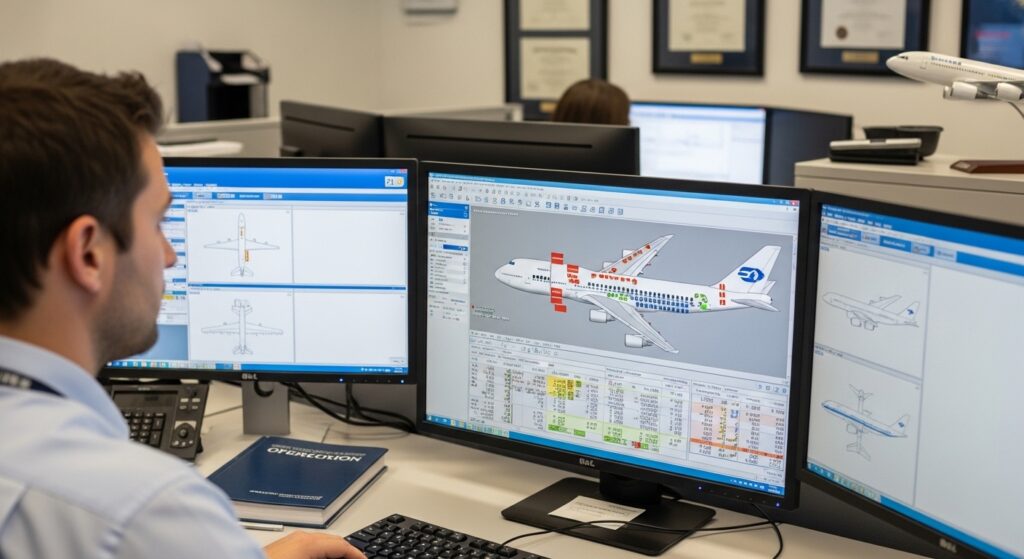
Bali Ground Handling operates industry-standard computerized weight and balance systems that provide accurate, auditable load calculations. We are certified to operate ALTEA Departure Control System (DCS) used by airlines in the Amadeus network, SITA eDCS for airlines in the SITA community, and GoNow and other airline-proprietary systems as required. These systems calculate center of gravity position, generate trim sheet data for the flight crew, produce load distribution instructions (LIR) for ramp loading teams, and flag any weight limit exceedances or CG deviations before loading begins.
For airlines not connected to computerized systems, our load controllers are fully qualified to perform manual calculations using approved aircraft-specific load planning charts, Dead Reckoning (DR) techniques, and standardized calculation forms — a critical capability for charter flights and ad-hoc operations.
Load Sheet & Trim Sheet Preparation
The load sheet is the primary flight safety document produced by load control, confirming that the aircraft is loaded within approved weight and balance limits. At DPS, our load controllers prepare computerized load sheets (CLSs) with complete weight breakdown including ZFW, TOW, and landing weight, trim sheet data showing stabilizer setting for takeoff, cargo and baggage distribution per compartment, last-minute changes (LMC) procedures for late passenger or baggage additions, and commander’s signature copy retained for airline records. Load sheets must be delivered to the flight crew before aircraft door closure, and our target is delivery at least 10 minutes before scheduled departure to allow crew review and query resolution.
Compartment Loading & Distribution
Correct distribution of payload across aircraft cargo compartments is essential for maintaining the center of gravity within approved limits. Our load planners create compartment loading instructions that specify which ULDs (Unit Load Devices), bulk baggage, and cargo items go into each compartment position. For narrow-body aircraft like the A320 and B737, this involves distribution between forward and aft bulk cargo holds. For wide-body aircraft like the B777 and A330, loading plans address forward lower cargo hold, aft lower cargo hold, and bulk cargo compartment, with ULD position assignments for containerized cargo.
Loading instructions are communicated to the ramp loading team in real-time, and any deviations from the planned loading sequence require immediate notification to load control for CG recalculation. This closed-loop communication ensures the aircraft is never loaded outside approved parameters.
Special Load Considerations at DPS
Bali’s unique traffic mix presents specific load control challenges that our team handles daily. Surfboard and dive equipment loads common on flights to and from Bali require special stacking and weight distribution considerations. Perishable cargo including seafood exports to Japan, South Korea, and Australia requires temperature-controlled positioning within cargo compartments. MICE event equipment loads for conferences and exhibitions at Bali’s convention facilities often involve heavy, oddly-shaped items requiring careful CG management. Dangerous goods shipments, including lithium batteries and chemical compounds, must be loaded in approved positions per IATA DGR regulations. Live animal transport requires ventilated hold positions with separation from other cargo categories.
Performance-Limited Departures from DPS
Bali’s Ngurah Rai Airport runway (3,000m/9,843ft) combined with tropical temperatures can create performance-limited departure scenarios, particularly for fully loaded wide-body aircraft on long-haul routes. In these situations, our load controllers work with airline dispatch to calculate Maximum Takeoff Weight adjustments based on runway available, ambient temperature and pressure altitude, wind component and runway slope, obstacle clearance requirements in the departure path, and engine-out climb gradient requirements.
When performance limitations require payload reduction, our load controllers coordinate with passenger handling and cargo teams to optimize offload decisions that minimize revenue impact while ensuring full regulatory compliance.
Certification & Training Standards
Load control personnel at Bali Ground Handling undergo comprehensive initial training (120+ hours) covering aircraft-specific weight and balance theory, DCS system operation, dangerous goods awareness, human factors in load control operations, and regulatory requirements per CASR Part 174. Annual recurrency training and competency checks ensure ongoing proficiency, with additional type-specific training whenever new aircraft types enter service at DPS. All load controllers hold DGCA-issued certifications and are subject to random proficiency audits by both airline customers and regulatory authorities.
What happens if an aircraft is loaded beyond weight limits?
Our computerized load planning systems automatically flag any exceedance of Zero Fuel Weight (ZFW), Maximum Takeoff Weight (MTOW), or Maximum Landing Weight (MLW) before loading begins. If actual weights exceed planned figures during loading, our load controllers immediately coordinate offload actions with the ramp team. No aircraft departs DPS without a fully compliant load sheet signed by the commander confirming all weight and balance parameters are within approved limits.
Which load planning systems do you support?
We are certified to operate ALTEA DCS (Amadeus), SITA eDCS, GoNow, and multiple airline-proprietary systems. For airlines without computerized systems or for ad-hoc charter operations, our load controllers perform manual calculations using approved aircraft-specific charts. System compatibility is established during airline onboarding and documented in the Station Handling Agreement.
How do you handle last-minute passenger changes?
Last-minute changes (LMC) are managed through a standardized procedure where gate agents communicate additions or removals to load control, who recalculate weight and CG, produce an amended load sheet if required, and update the ramp team on any baggage loading changes. Our target is to process LMCs within 3 minutes to prevent departure delays while maintaining full weight and balance accuracy.
Request Load Control Services at DPS
Contact Bali Ground Handling for certified load planning and weight balance services at Ngurah Rai Airport.
Load Control & Planning FAQ
What is load control in aviation?
Load control is the process of calculating and distributing passenger, baggage, cargo, and fuel weight to ensure aircraft balance and safety. Proper load planning determines the center of gravity, ensures weight limits are not exceeded, and generates the official load sheet required for every commercial flight.
Why is load control important for flight safety?
Incorrect load distribution can shift the aircraft’s center of gravity beyond safe limits, affecting controllability, fuel efficiency, and structural integrity. Professional load control ensures every flight operates within the manufacturer’s certified weight and balance envelope.
What systems do you use for load control?
We use industry-standard Departure Control Systems (DCS) compatible with major airline platforms. Our systems generate real-time load sheets, trim sheets, and NOTOC (Notification to Captain) documents in compliance with IATA and ICAO requirements.
Do you provide load planning for private jets?
Yes, we provide weight and balance calculations for private and charter aircraft. Even smaller aircraft require accurate load planning to ensure safe operations, particularly when operating at maximum range or in challenging weather conditions.
How do you handle special cargo loading?
Special cargo including dangerous goods, live animals, perishables, and oversized items requires specific loading positions and compatibility checks. Our load planners are trained in IATA Dangerous Goods Regulations and follow strict loading protocols for all special cargo categories.
Can you integrate with airline DCS systems?
Yes, we support integration with all major Departure Control Systems including Amadeus Altea, SITA eDCS, and Sabre AirCentre. Seamless DCS integration ensures accurate passenger and baggage reconciliation for every departure.
Need assistance? Contact our team for expert support.
Email: [email protected] | Phone: +62 811 3809 193