Aviation Professional Reference
Ngurah Rai Airport Guide for Airlines & Operators
Operational reference guide covering airfield data, ATC procedures, ground handling infrastructure, and aviation services at DPS/WADD
Aerodrome Data & Technical Specifications
Ngurah Rai International Airport is classified as Airport Reference Code 4E under ICAO Annex 14, capable of accommodating aircraft up to Boeing 747-400 and Airbus A380 (with operational restrictions). The aerodrome is situated on the isthmus connecting Bali’s mainland to the Bukit Peninsula, with the runway built on reclaimed land extending into Benoa Bay. Geographic coordinates are 08°44’52″S 115°10’04″E with an elevation of 14 feet (4.3m) above mean sea level.
The airport’s coastal location creates specific operational considerations including crosswind components from sea breezes, salt corrosion risk to ground support equipment, and occasional low visibility during the wet season due to maritime fog and tropical precipitation. Airlines planning operations at DPS should factor these environmental conditions into their operational risk assessments.
Runway & Taxiway System
The single runway 09/27 measures 3,000m x 45m with PCN (Pavement Classification Number) rated for all commercial aircraft types currently operating at DPS. Runway surface is grooved asphalt providing effective drainage during tropical rainfall. Approach and landing aids include ILS CAT I on both runway 09 and 27 approaches, PAPI (3-degree glide slope) on both thresholds, DME co-located with ILS, NDB and VOR/DME for non-precision approaches, and high-intensity approach lighting system (HIALS).
The parallel taxiway system provides efficient aircraft movement between the runway and apron areas. Multiple rapid exit taxiways reduce runway occupancy time during high-traffic periods. Maximum declared distances are TORA/TODA/ASDA/LDA of 3,000m for both directions, with displaced thresholds depending on obstacle clearance requirements published in the AIP.
ATC & Airspace Information
DPS is served by Bali Approach Control operating within the Bali Terminal Maneuvering Area (TMA) and Ngurah Rai Tower for aerodrome control. Standard Instrument Departures (SIDs) and Standard Terminal Arrival Routes (STARs) are published in the Indonesian AIP and updated through AIRAC cycles. Communication frequencies, ATIS information, and NOTAM procedures follow ICAO standards managed by AirNav Indonesia (Perum LPPNPI).
Airlines establishing new routes to DPS should coordinate with Indonesian ATC authorities through their operations department. Bali Ground Handling assists with local operational coordination but does not provide ATC services. For flight permit and slot coordination, our dedicated team manages the regulatory liaison process.
Apron & Aircraft Parking
The airport apron complex comprises multiple parking areas configured for different aircraft categories and operations. The international apron provides contact stands (with aerobridges) for wide-body and narrow-body aircraft, remote stands for overflow and low-cost carrier operations, and dedicated cargo aircraft parking positions. The domestic apron serves regional and domestic aircraft with both contact and remote stand configurations. A general aviation apron accommodates private jets and business aviation with FBO-style facilities.
Aircraft parking is allocated by Angkasa Pura I operations control based on airline schedules, aircraft type, and ground time duration. Bali Ground Handling coordinates stand assignments with airport operations to ensure optimal positioning for our ground handling activities and ramp service delivery.
Fuel Facilities
Aviation fuel at DPS is supplied exclusively by PT Pertamina (Persero) through the airport fuel farm located adjacent to the cargo complex. Jet A-1 fuel meeting AFQRJOS (Aviation Fuel Quality Requirements for Jointly Operated Systems) specifications is available via hydrant system at major stands and bowser delivery to remote stands and general aviation positions. Fuel quality control follows IATA Fuel Quality Pool (FQP) and JIG (Joint Inspection Group) standards with regular sampling and testing. For fuel procurement and delivery coordination, see our fuel coordination services.
Cargo & Mail Facilities
DPS cargo complex includes import and export warehouse facilities managed by Angkasa Pura Logistik, cold storage for perishable goods (critical for Bali’s seafood and agricultural exports), dangerous goods storage compliant with IATA DGR requirements, customs examination areas for both import and export cargo, and bonded warehouse facilities for transit cargo. The cargo complex handles approximately 78,000 tons per quarter with 9% year-on-year growth, reflecting Bali’s expanding role in regional cargo logistics. Our cargo handling team operates within these facilities providing complete cargo acceptance, processing, and delivery services.
Emergency & Safety Services
Ngurah Rai Airport maintains ICAO Category 9 fire and rescue services (the second-highest category), capable of responding to incidents involving the largest aircraft types. Airport Rescue and Fire Fighting (ARFF) services include foam tenders and rapid intervention vehicles positioned for 3-minute response to any point on the runway. Medical services are provided by an on-airport medical facility with ambulance capability. Emergency procedures follow the Aerodrome Emergency Plan (AEP) coordinated through Angkasa Pura I’s Airport Emergency Committee.
Climate & Weather Considerations
Bali’s tropical maritime climate creates consistent weather patterns that affect flight operations. The dry season (April-September) provides generally clear conditions with predictable sea breezes creating afternoon crosswind components. The wet season (October-March) brings tropical convective weather with potential for thunderstorms, reduced visibility, and gusty winds. Volcanic activity from nearby Mt. Agung can occasionally produce ash advisories affecting operations. The Darwin Volcanic Ash Advisory Centre (VAAC) monitors volcanic activity and issues advisories per ICAO procedures. Airlines should factor these seasonal weather patterns into schedule planning and fuel policy decisions for DPS operations.
What aircraft types can operate at DPS?
DPS accommodates all commercial aircraft types from ATR 72 turboprops to Boeing 747-400 and Airbus A380 (with operational restrictions). The 3,000m runway and 4E airport reference code support wide-body long-haul operations. Aircraft performance should be calculated considering DPS’s sea-level elevation and tropical temperatures, which can reduce takeoff performance, particularly for fully loaded wide-body aircraft on long-haul sectors.
How do airlines establish ground handling at DPS?
Airlines can establish ground handling services at DPS by contacting Bali Ground Handling for a service quotation based on their operational requirements. We provide full SGHA-compliant handling customized to airline specifications, with onboarding typically completed within 2-4 weeks including system connectivity, staff training, and procedure documentation. Contact our commercial team to begin the process.
Is there an FBO for private jets at Bali airport?
While DPS does not have a standalone FBO facility, Bali Ground Handling provides FBO-equivalent services for private jet operations including dedicated parking, VIP terminal access, customs/immigration facilitation, fuel arrangement, and comprehensive aircraft servicing. Our private aviation team delivers seamless business aviation ground support at DPS.
Start Operations at DPS
Contact Bali Ground Handling for airline onboarding and ground service agreements at Ngurah Rai Airport.
Ngurah Rai Airport Guide FAQ
Where is Ngurah Rai International Airport located?
Ngurah Rai International Airport (DPS) is located in Tuban, southern Bali, approximately 13 km south of Denpasar city center. The airport sits on a reclaimed land peninsula between Jimbaran Bay and Benoa Bay, providing convenient access to most tourist areas in Bali.
How many terminals does Bali airport have?
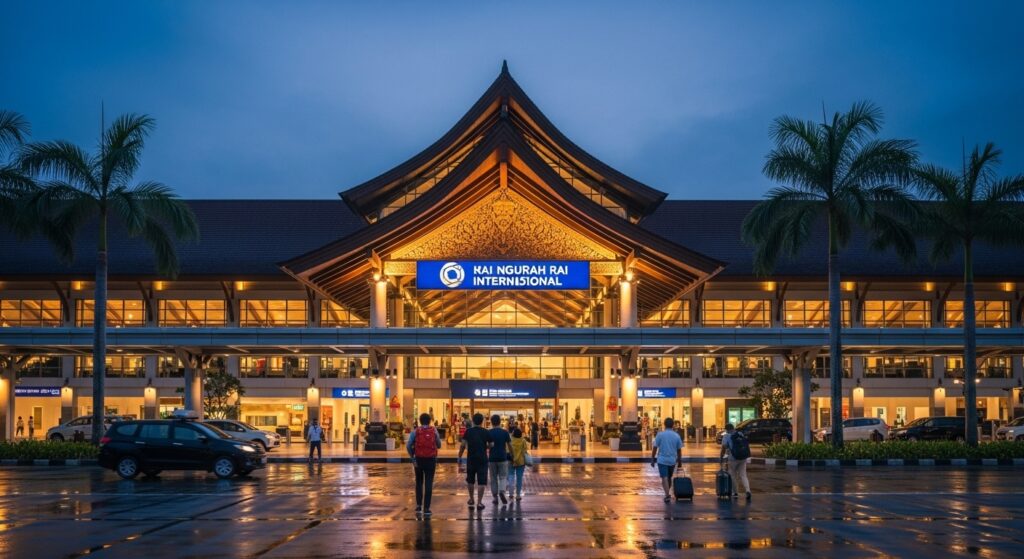
Bali airport has three main facilities: the International Terminal (Terminal 1) for international flights, the Domestic Terminal (Terminal 2) for domestic flights, and the General Aviation Terminal (GAT) for private jets and charter flights. Both main terminals were modernized in 2013 with Balinese architectural design.
What facilities are available at Bali airport?
The airport offers restaurants, cafes, duty-free shops, currency exchange, ATMs, VIP lounges, prayer rooms, smoking areas, baby care rooms, medical clinic, lost and found, tourist information, car rental counters, and free WiFi throughout both terminals.
Is there a train or shuttle from Bali airport?
There is no train service to Bali airport. Transportation options include metered taxis, ride-hailing apps (Grab, Gojek), hotel shuttles, and private car transfers. VIP travelers can arrange luxury vehicle transfers through Bali Ground Handling for a seamless arrival experience.
What is the best time to arrive at Bali airport for international flights?
We recommend arriving 3 hours before international flights and 2 hours before domestic flights. During peak season (July-August, December-January), allow extra time for longer immigration and security queues. VIP fast-track services can significantly reduce processing time.
Does Bali airport have a transit hotel?
While there is no airside transit hotel, several hotels are located within 10 minutes of the airport including luxury options in the Jimbaran area. For extended layovers, VIP lounge access with shower facilities and rest areas can be arranged through Bali Ground Handling.
Need assistance? Contact our team for expert support.
Email: [email protected] | Phone: +62 811 3809 193